Call Center Dialer for Small Teams: Per-Seat Plans vs Pay-Per-Minute
Power, predictive or preview dialer? What a 3 to 15 person outbound team needs, what per-seat dialers cost you, and when pay-per-minute wins.
Get a numberUK & US numbers from $2.00/month
Need a UK or US number? Get one from $2.00/month, no SIM →
A call center dialer places outbound calls for your team from a lead list, so agents spend their time talking instead of dialling. For a small team of 3 to 15 callers, the right choice usually comes down to two questions: which type of dialer suits your calls, and whether you pay per seat every month or only for the minutes you use. This guide answers both, for agencies and outsourcing teams calling the US and UK.
The four types of dialer
| Type | How it dials | Best for |
|---|---|---|
| Manual / click-to-call | Agent clicks each number | A few calls a day, account management |
| Preview | Shows the lead, agent decides when to call | High-value B2B leads that need research first |
| Power (progressive) | One call per agent, next call starts when the last ends | Small B2B teams cold calling lists |
| Predictive | Several calls per agent at once, connects the answered ones | Large consumer call centres with big lists |
Predictive dialing sounds the most efficient, but it needs volume to work. With five agents it regularly connects a prospect when nobody is free, so the prospect hears silence and hangs up. Business buyers in the US and UK don't give you a second chance after that, and regulators in both countries limit how many calls a dialer may abandon. For a small B2B team, a power dialer gives most of the speed without those problems.
What a small outbound team actually needs
- Lead import: load a CSV from your lead tool and start calling in minutes.
- Auto-advance: the next call starts when the last one ends.
- Outcomes: interested, callback, no answer, not interested, do not call, with notes.
- Local caller IDs: a US number for US leads, a UK number for UK leads.
- A manager view: calls, talk time and spend per agent, and what was said.
- Predictable cost: no surprises when the team grows or slows down.
Features such as IVR menus, inbound queues, call routing, built-in CRMs and predictive algorithms matter to large call centres. A five-person agency pays for them in its seat fee without using them.
Per-seat plans vs pay-per-minute
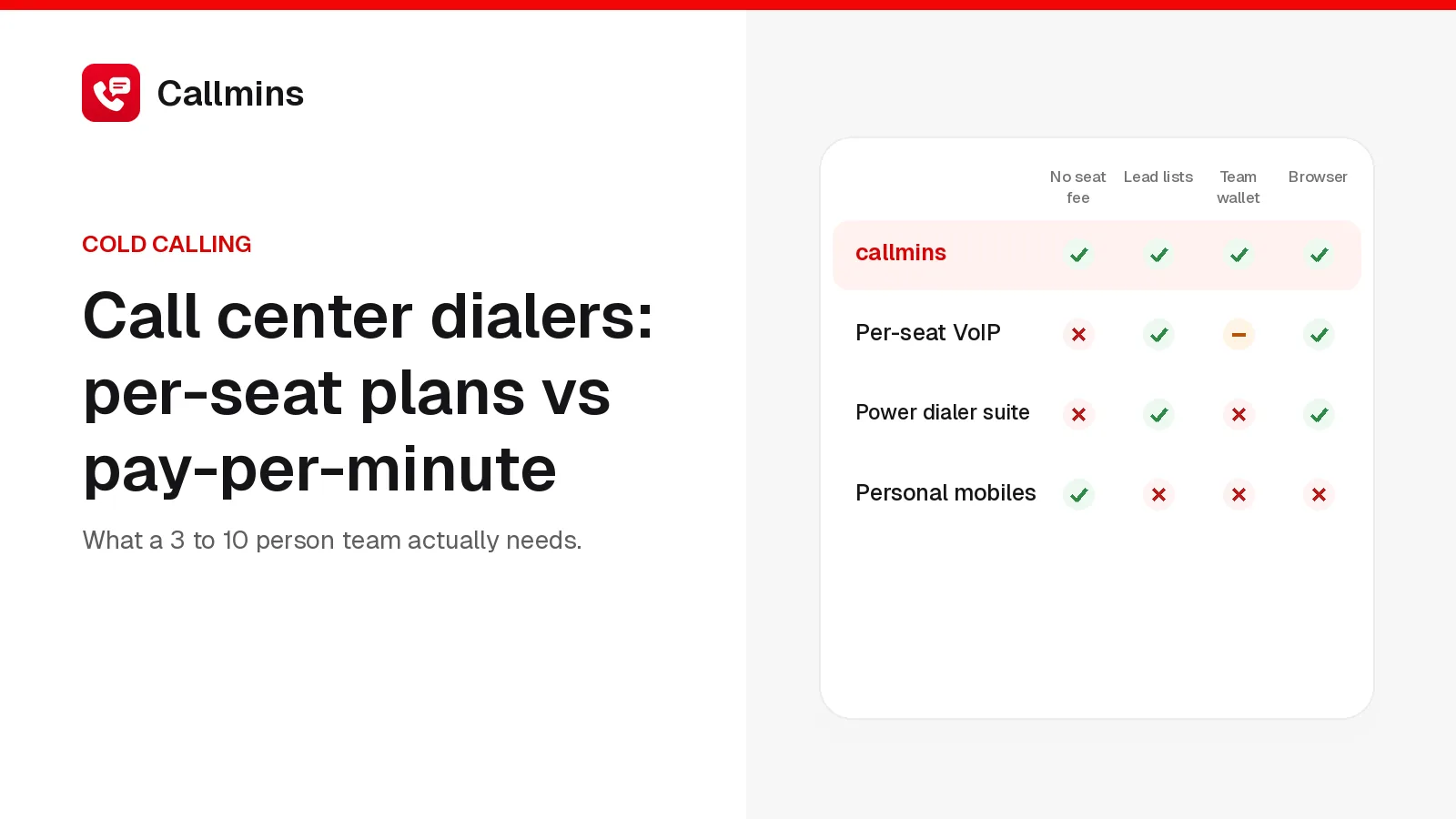
Most call center dialers, including popular choices such as Mojo, CallHippo and the unified-communications suites, are sold per user per month. That works when every seat is busy all day. It works less well for the way small agencies actually call:
- Callers are often part-time, or split calling with project work.
- Teams grow for a campaign and shrink after it; seats are billed either way.
- International minutes may be limited, extra, or priced differently by plan.
Pay-per-minute flips the model: no seat fee, and the bill follows the calling. As a worked example on callmins, five callers who each talk for 90 minutes a day, 22 working days a month, use 9,900 minutes. At about 1.68¢ a minute to the US that is roughly $166.32 a month for the whole team, plus $2.00/month, no setup feefor each US caller ID. Check any dialer's current pricing page against your own team size and minutes before you decide.
Per-seat products win when you need what they bundle: predictive dialing, call recording with long retention, inbound queues or a deep CRM integration. Pay-per-minute wins when you want a lean outbound setup and a bill that matches usage.
How callmins fits a small team
callmins is a browser-based power dialer with virtual numbers, built for small outbound teams:
- The Auto Dialer imports your lead CSV, matches the phone, name and company columns for you, and dials one lead after another.
- Callers mark each outcome and add notes; attempts are counted per lead.
- Each caller shows a US, UK or Canadian number as caller ID.
- A company accountputs every caller on one prepaid wallet; the admin sees each caller's calls, talk time, spend and, with transcription on, transcripts.
- Nothing to install: callers work in the browser with a headset.
It isn't a predictive dialer and doesn't run inbound queues or IVR menus. If you need those, a full call center platform is the better fit. For teams calling a few hundred leads a day, see the cold call dialer guide for agencies and the calling playbook.
A checklist before you choose
- How many callers, and how many hours each actually spend on the phone?
- B2B or consumer? Power dialing suits B2B; predictive suits large consumer lists.
- Which countries do you call, and can you show a local number there?
- What is the real monthly cost for your team: seats, minutes, numbers and add-ons?
- Can a manager see every call, outcome and transcript without asking the caller?
- How fast can a new caller start: install, training, approval?
Common questions
What is a call center dialer?
A call center dialer is software that places outbound calls for a team of agents from a list, instead of agents dialling by hand. Depending on the type, it dials one number at a time per agent (power or progressive), lets the agent review the lead first (preview), or dials several numbers per agent and connects only answered calls (predictive).
What is the difference between a predictive dialer and a power dialer?
A power dialer calls one number per agent and dials the next as soon as the previous call ends. A predictive dialer calls several numbers per agent at once and guesses when an agent will be free. Predictive dialers suit large teams on consumer lists; with small teams they drop calls and leave silence when the prospect answers, which annoys business buyers and can break calling rules.
How much does a call center dialer cost for a small team?
Most dialers charge a monthly fee per agent, often with calling minutes on top or bundled with limits. Pay-per-minute tools charge only for calls made. On callmins, calls to the US cost about 1.68¢ a minute with no seat fee: five callers talking 90 minutes a day for a month would spend roughly $166.32 on calls.
Do I need a VoIP dialer or can agents use their phones?
For international outbound calling, a VoIP dialer is almost always cheaper and gives you local caller IDs, call logs and outcomes in one place. Calling from personal phones leaves the business with no record and shows an international number to every prospect.
The short version
- Small B2B teams get most of the speed from a power dialer, without predictive's dropped calls.
- Per-seat plans suit full-time call centres; pay-per-minute suits agencies whose calling varies.
- Whatever you choose, use local caller IDs and log every outcome.